
The BRB Bottomline: BRB Columnists were invited to a World Financial Group (WFG) branch where they learned about “paying it forward,” the Exchange Principle, company-wide trips to Vegas, and everything it takes to make it rich by selling life insurance—all while our recruiter tried to sell us an insurance policy, hundreds of dollars of license fees, and the opportunity of a lifetime.
“This is the business opportunity of a lifetime.”
He smiled and handed us his business card along with the dreams of becoming a successful entrepreneur .
Silver letters, WFG, glittered against the white background.
Former Agents Call World Financial Group a Scam
World Financial Group (WFG), owned by Transamerica, is a multi-level marketing (MLM) company that sells financial products like life and health insurance.
MLMs like WFG use a direct selling strategy, “person-to-person selling” outside the traditional retail setting (using social media, at home etc.), to sell a product. However, these products are often only used, according to the Federal Trade Commission (FTC), to “hide” the company’s “pyramid structure”. This hierarchical structure, composed of superior members recruiting new members to work under them, is small at the top and broadens at the bottom as the cycle of recruitment continues, creating the pyramidal shape. Current members earn upfront fees and a commission from sales made by new distributors that they recruit, moving the emphasis from selling the product to a consumer base in order to meet real demand to expanding the MLM network.
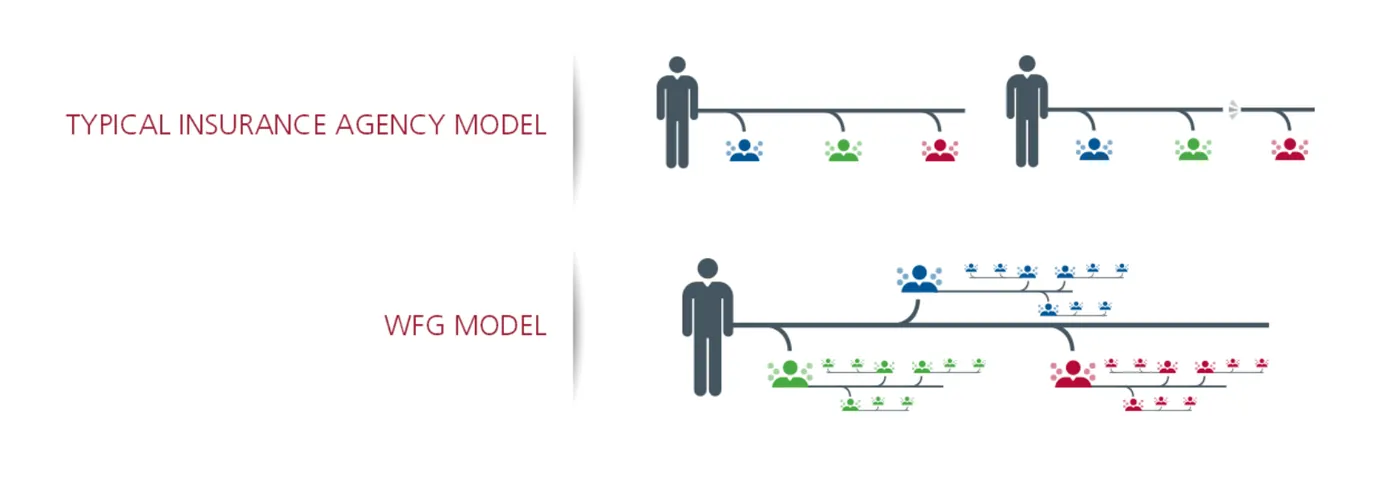
On the website of an independent WFG agent, we found a schematic of WFG’s business opportunity, cleverly designed to conceal the pyramid-like structure with a graphic depicting a visually linear model.
By turning the pyramid horizontally, Boyd and WFG try to make it seem like recruits can somehow end up on top of their recruiters. Rearranging the schematic such that direct recruits are arranged downwards reveals the pyramid-like structure.
This multi-level pyramid structure requires too many recruits to sustain and is destined to collapse. At the ninth level of a pyramid scheme in which each member must recruit only nine new members, 387 million or more people must be members to sustain the business, surpassing the population of the US, according to the Cornell Legal Information Institute. A former agent at It Works, an MLM selling beauty and weight loss supplements, told her firsthand experience of the flawed structure: “We were negative $1,000 after 18 months. And being within the top 10% at least of the company,” according to reporting by Business Insider.
Laws have been put in place to prevent this flawed business scheme from taking advantage of people. The FTC Koscot decision in which Koscot Interplanetary, Inc. was told to cease and desist as an illegal chain marketing system, found two criteria for a direct selling association to be unlawful: 1) participants must pay the company for the right to sell a product, and 2) participants have the right to receive in rewards in return for recruiting other participants into the program, which is unrelated to the sale of the product to ultimate users.
These laws have targeted WFG in the past. In 1999, they paid fines of $100,000 for not supervising sales agents properly. In 2000, they paid $125,000 for not reporting customer complaints. Just a simple Google search reveals the unreliable, untrustworthy history of the company.
Because anticipating the infinite number of loopholes and technicalities MLM founders might come up with is impossible, laws are “drafted and interpreted very broadly”. Legal decisions are based on “whether features of the MLM compensation structure incentivize or encourage participants to purchase product for reasons other than satisfying genuine demand” “information bearing on whether purchases were in fact made to satisfy personal demand to consume the product” (FTC).
However, this could also make pinpointing and taking legal action against MLMs even more confusing. In the case of WFG, despite litigation, the company is still functioning and considered a legitimate business operation.
MLM salespeople hide the questionable legal history and the unsustainability of the company’s pyramid structure extremely well behind the facade of targeting serious entrepreneurs and promising success. A former MLM World Financial Group (WFG) agent comments on a public forum that they make promises of wealth and a luxurious lifestyle, “recruiting on the premise of being a millionaire”. “For anyone who still has a dream, Start Here,” the WFG website says. MLMs take advantage of gullible high school, college, and working people, and are like “cults,” “recruit[ing] people based on relationships” and “target[ing] people who are at vulnerable places in their lives” Professor Jennifer Chatman at the Haas School of Business explains.
In Las Vegas for a long weekend in August, WFG held its 2019 Convention, WFG C19, as people in the industry affectionately call it. As third party observers, we wonder how these people justify to their clients why their financial adviser was at a huge party in Las Vegas. In any case, the event was broadcasted live and WFG agents themselves posted videos of the conference.
One such video shows Guillermo Haro, a WFG Senior Executive Vice Chairman (SEVC), on stage roleplaying common scenarios that agents encounter while recruiting. Here’s Haro’s answer to “Is this Multi-Level Marketing?”
“Everything that I’m aware of is multi-level marketing. If it weren’t multi-level, that means it would be uni-level. That means everybody would make the same, everybody would have the same title. Think about your family. Aren’t you and your family sort of multi-level? Aren’t you and your dad and your grandfather different people, different levels, different ages? Everything out there that is organized is multi-level.”
Guillermo Haro
WFG Senior Executive Vice Chairman
Haro is a convincing character in person. In writing, his logical errors are easier to spot. He goes from admitting that “Everything…is multi-level marketing,” including WFG, to explaining how multi-level things are common. The definition of multi-level marketing isn’t that it has multiple levels. The definition of multi-level marketing is that salespeople sell to the levels below them. In that case, WFG is an MLM but not everything is multi-level marketing.
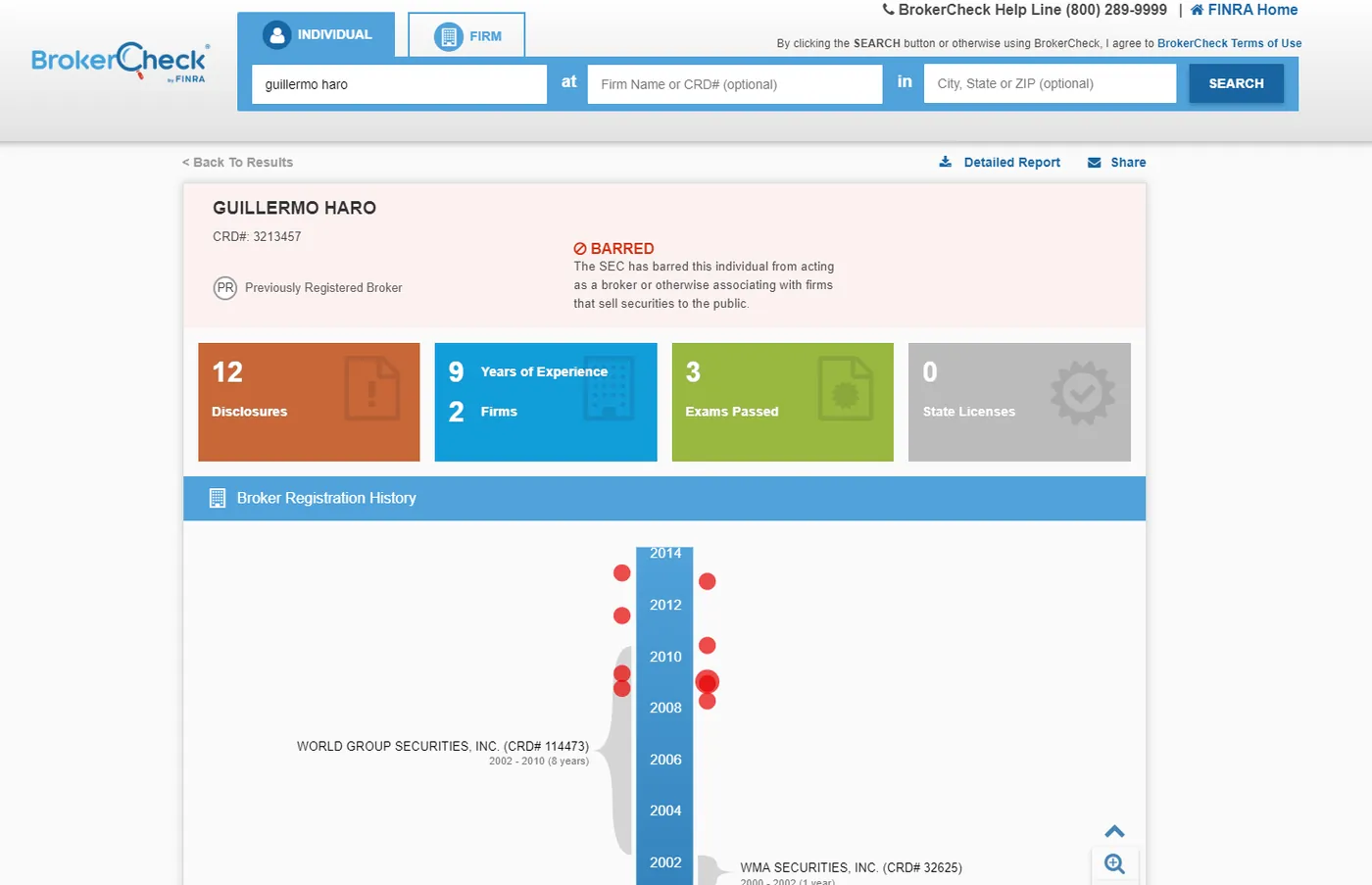
In 2010, the SEC barred Haro “from association with any broker or dealer with the right to reapply for association in the capacity as a registered representative after (1) year and as a supervisor after four (4) years.”
The SEC came to this decision after Haro advised his clients to refinance the equity in their home with subprime mortgages and reinvest the proceeds into the stock market. This all while collecting a huge commission on the transaction.
On BrokerCheck, Haro is still barred by the SEC “from acting as a broker or otherwise associating with firms that sell securities to the public.”
As crazy as this all sounds, none of this is new information. Online forums and other sources have warned of the fraudulent activity and misleading characters that have floated around MLMs and specifically WFG for years now.
Rather, our story—our firsthand experience of getting recruited into an MLM—begins at a Berkeley-Haas event where a WFG agent, who was not even a Berkeley-Haas alumni, handed us his business card.
Peddling Hopes to the People Closest to You
Our WFG recruiter introduced himself as a financial adviser. That’s not entirely true because financial advisers are bound by a Fiduciary Standard; whereas, broker-dealers only have to abide by a Suitability Standard. Legal and functional differences aside, the logo on their business card intrigued us because we had gotten a similar business card with that logo from an uber driver just the semester before.
After exchanging contact information, we began talking with our WFG recruiter over Facebook messenger. He invited us to visit him in their office. We accepted.
At several points before we left Berkeley and before sitting down with our recruiter, we reminded him that the reason we agreed to meet was to learn more about financial advisory, more specifically, how WFG operates as a business by distributing financial products.
We told our recruiter that we were both students and part of Business Review at Berkeley covering a story on how financial products are distributed. Both times we sought to clarify the reason for our meeting, the agent emphasized that he was excited to evaluate us as business partners. The recruiter escorted us into a small conference room where we interviewed each other for two hours.
Our recruiter set his arms on the table and appeared to examine each of us intently.
“This will be a difficult business venture. You have to be a hustler. This is not a job. There are 70,000 real estate agents and only 40,000 homes sold last year. WFG does not guarantee returns, but, if you put in the effort to run this business, you can make a lot of money.”
Conversation with our WFG Agent/Recruiter
Our recruiter also emphasized this to us in our private messages before the meeting.
“This is not an internship. I’m actually [sic] looking for business partners, so if that’s something you’re open to I would love for you guys to come in but I’m looking for someone who’s really ambitious to start their own business and can take initiative…I just want to make sure that we’re not wasting each other’s time because I really want to work with someone who is entrepreneurial-minded not employee minded.”
Private messages with WFG agent
This is a common tactic that WFG agents employ. They create a facade of exclusivity and prestige to lure gullible greenhorns to the office. They insist on only sharing details about the business opportunity in person because their selling techniques are more persuasive in person.
One source worked at a WFG office and sent us a training presentation that recruiters give to new recruits.
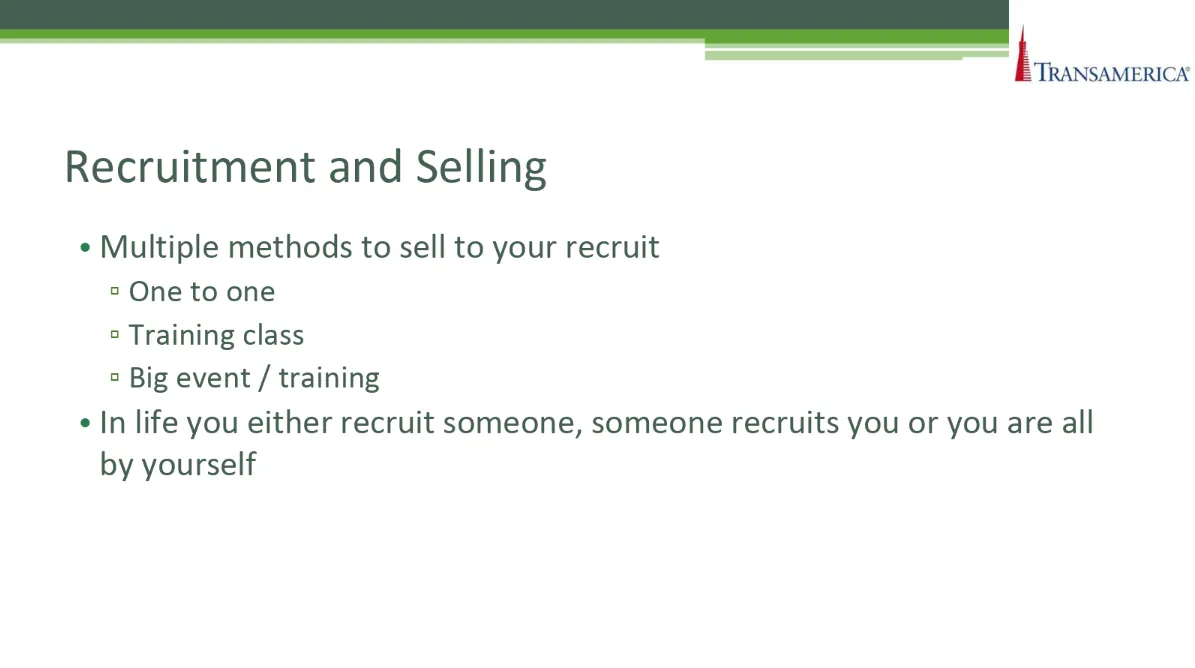
The fact that WFG agents are explicitly taught “multiple methods to sell to your recruit” shows the emphasis the company places on recruiting and selling product to recruits.
We found a WFG Transamerica Compensation & Promotion Guidelines brochure that has a helpful diagram showing the four different ways agents can earn income.
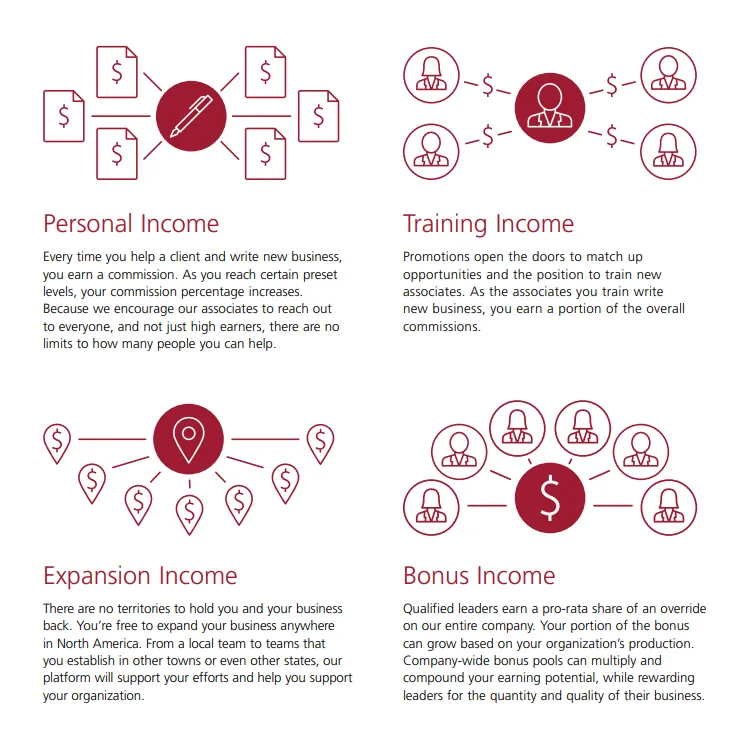
Notice that Personal Income is the only way agents earn money by actually selling insurance to WFG clients. The other three ways (Training, Expansion, and Bonus Income) come from selling products to new recruits, i.e. WFG agents, themselves.
Our recruiter explained the situation much more cogently than we could hope to:
“Selling is linear. Even though you make 100% of the commission, it’s slow. Spreading is playing the long-game. You only have 24 hours in a day. But, you have an infinite amount of selling time if you recruit enough people.”
Conversation with our WFG Agent/Recruiter
According to our recruiter, the Senior Managing Director (SMD) of this branch earned $890,000 last year. Only $200,000 of that came from actually selling insurance, most of which probably came from personally selling to new recruits, though our recruiter didn’t make the distinction.
What is clear from his testimony is the majority, the other $690,000, was from the recruited agents below him. Commissions from associates this SMD recruited (Training Income) as well as Bonus Income from putting people below them on the generational ladder made up more than 75% of his salary.
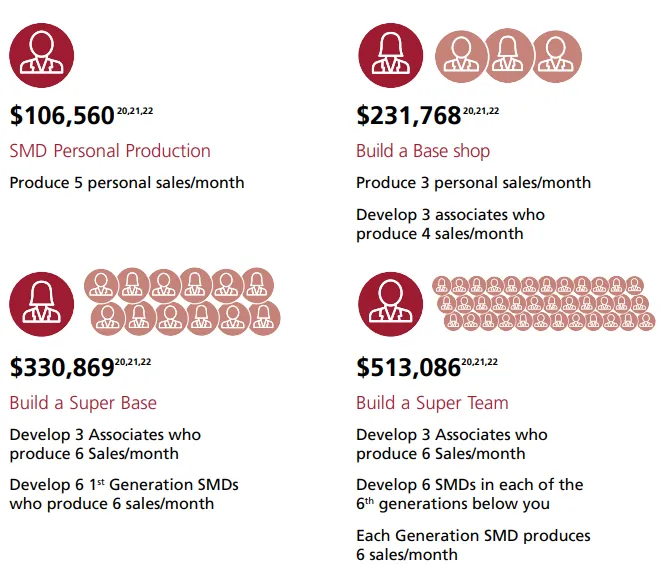
The diagram above shows how producing your own sales will barely get you above $100K in gross income a year. Moreover, these WFG-provided calculations assume that the SMD sells five personal sales per month, which is one sale every week. Our recruiter hadn’t made a sale in two weeks.
When we asked our recruiter how much an agent could theoretically make if they just sold the product and didn’t recruit business“You won’t break $100K a year,” he replied.
The dream WFG sells is one about putting people below you in the pyramid. So, what exactly do recruiters sell to new agents?
Starting Off Thousands of Dollars in the Hole
The first thing our recruiter tried to sell us was access to their Wednesday night training programs, which are offered through a wholly-owned subsidiary of WFG called World System Builder (WSB). Training programs are another way WFG tries to give off the image of legitimacy.
Lifetime membership to WSB, which gives you access to these training programs, costs $100. Every recruit has to pay for membership in order to move on in the recruiting process.
Agents are incentivized to sell potential recruits these $100 lifetime memberships to attend business classes for two reasons.
First, when recruits sign up to join the class, they are asked to put their recruiter’s name. This gives the recruiter base points. If an agent racks up enough base points, they qualify to go on expenses-paid trips to different places. The current contest period offers agents the opportunity to go to Xi’an, China.

Second, training programs are a marketing funnel for recruiters to gauge or stoke a recruit’s interest in becoming an agent themselves. We told our recruiter that we would think about paying for the training program until after we heard the rest of the business opportunity.
Our recruiter then told us about licenses. He said life and long-term care (LTC) insurance is about 80% of their business. Testimonies online confirm that the most common product these agents sell is Transamerica’s Financial Foundation indexed Universal Life (FFIUL) policy.
Indexed universal life insurance policies are the most complex and expensive policies brokers sell, which means they pay the highest commission.
The license our recruiter told us we needed is called Life and Health License.
“The [Life and Health License] course is $150 with smaller brokers but only $30 if you sign up with us because we’re a bigger broker.”
Conversation with our WFG Agent/Recruiter
Moreover, our recruiter told us that agents have to pay a $60/month Errors and Omissions insurance premium “so that if the branch were to be sued, you don’t have to show up in court.”
At the end of the meeting, we asked the recruiter to requote us how much it would cost to get started. He said it would cost $1,000 to get started. On the bright side, however, our recruiter told us that, because agents are business owners, they are allowed to take annual business losses of up to $10,000 to $20,000.
Our recruiter benefits from all of these costs new recruits pay WFC and FINRA by racking up base points; however, most of the cash is made once the recruit is up and running.Our recruiter told us about the “Exchange Principle,” a policy of their branch where the first three appointments that new recruits find are given to their recruiter.
After the meeting, we told our recruiter that we thought WFG is a multi-level marketing scheme because it appears that the majority of product sales come from sales to new recruits and asked him for comments. Without any prompting, he said, “WFG isn’t a pyramid scheme because recruits can theoretically supersede their recruiters.”
After everything our recruiter told us during the meeting, it was difficult to not see the irony. Surpassing your recruiter is impossible if your recruiter gets half of all the business you do.
Moreover, everything our recruiter told us during the meeting was around respecting the structure of the branch, rather than breaking away from it. We asked our agent whether we could just break off from the SMD’s branch, cut him out of our future business, and start our own branch. Our recruiter’s response exemplified the success WFG has had on convincing its agents to trust that WFG is the answer to their lives.
“We can’t break away from the arm created by the Senior Marketing Director of our branch. We are grateful to our SMD. Without our SMD creating this branch, we wouldn’t be having this meeting.”
Conversation with our WFG Agent/Recruiter
Conflicts of Interest Everywhere You Look
Selling financial products is wrought with potential conflicts of interests. One way the financial industry has tried to combat conflicts of interest is to establish standards that financial actors must follow. Agents working as broker-dealers are sworn by a Suitability Standard to find the right product for their clients’ needs. This standard is lower than the Fiduciary Standard, which investment advisers working directly with clients must follow.
Transamerica, one of the largest insurance companies in the U.S., owns WFG. The agents at WFG are sworn by the Suitability Standard to recommend the best product for their clients’ needs.
However,
“You are a contractor. No employee benefits. You’re basically a marketer for Transamerica insurance products. There are other companies and products available but most branches and teams have little to no knowledge of them. This is an issue considering the company advertises that they find the right company/product for the client amongst their many partners. If you’re interested you have to teach yourself.”
Glassdoor
Our recruiter confirmed this apparent conflict of interest. “Transamerica pays us more. The commission is about 25% higher for Transamerica products.”
Moreover, WFG does not necessarily have the best interest of their agents in mind. WFG agents aren’t employees of WFG. They’re independent agents associated with WFG. WFG agents are taught to recruit on this premise as well by telling recruits that this isn’t a job but rather a business opportunity. WFG doesn’t pay its associates benefits or salaries. In this system, WFG is merely a branding and cult organization that ostensibly connects all these independent agents together. Advertisements on the company website promote the many, many WFG training events that, unfortunately for agents, end up costing quite a bit. One event called Project Titan teaches associates how to “Unleash the Big Baseshop.”
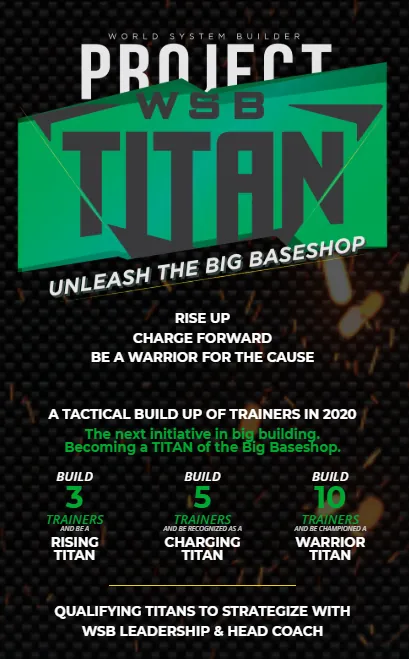
Selling gimmicks, like training tools and event tickets, is one way WFG, the corporate entity, leeches money from its associates.
Take Home Points
Disguised as once-in-a-lifetime business opportunities, Multi-Level Marketing schemes have a pyramid structure that is doomed to fail. Although laws have been passed in hopes of preventing them from taking advantage of vulnerable, hopeful people, they continue to operate, difficult to pin down. Our experience provides an inside look on the process an MLM agent undergoes in order to recruit new agents and expand the pyramid as well as the core problems of the business’ internal workings.
Finally, always be wary! Despite the plethora of warnings, people are still roped in by cunning agents, believing every single word. In fact, our own MLM agent did not believe that he was working for a multi-level marketing, pyramid scheme. So, when handed a flashy business card for an opportunity that is just too good to be true, look for the signs that have been broken down by this article!